
*****SPORE-DRIVE SPOILERS!******
Premiering in September of 2017 on the then all-new “CBS All Access” streaming service, which quickly became ParamountPlus, “Star Trek: Discovery” (DSC) has finally ended a five-season run; a season earlier than expected. Five seasons is two seasons more than the original “Star Trek” (1966-9), though a couple seasons shy of most Star Trek series post-1987 (“The Next Generation,” “Deep Space Nine,” “Voyager”). Like “Voyager” and the now-defunct UPN network, DSC was intended to be the flagship for an all-new CBS/Paramount streaming platform, and it succeeded, more or less.

Sonequa Martin-Green as Michael Burnham, first officer of the USS Shenzhou in Star Trek: Discovery’s pilot episode, “The Vulcan Hello,” which reimagined Vulcans as the sort who strike first and ask questions later, which is wildly contrary to their pacifist reputation.
The wildly uneven series that followed over the next five seasons and seven years (with patience-taxing hiatuses) was a genuine mixed bag; a good core cast (Sonequa Martin-Green, Doug Jones, Wilson Cruz, Anthony Rapp, Mary Wiseman, Blu del Barrio, and David Ajala) and gallery of recurring characters (Oscar-winner Michelle Yeoh, Jason Isaac, et al) who routinely overshadowed the secondary bridge crew characters (whose names I still can’t recall off the top of my head, even after five seasons). There was some behind the scenes turbulence in the first and second seasons, as well (the exits of producers Aaron Hebert, Gretchen Berg), which led to the appointment of new showrunner Michelle Paradise in season 3.

While Paradise’s appointment seemed to put a doorstop in the revolving door of the show’s production staff, the show’s mixed-bag of episodes was still an issue. DSC’s scripts often felt more like protracted video-game quests and therapy sessions rather than honest storytelling. The show often sends its characters all over the universe to find clues and solve puzzles rather than tell stories. Characters also tend to awkwardly stop whatever they’re doing (hands dropped to their sides) to discuss how they’re feeling. This tendency has given the series a reputation as ‘the emo Star Trek.’ That reputation is not unfounded. The addition of “Battlestar Galactica” veteran Callum Keith Rennie as Discovery’s hard-nosed, Kelluran first officer Commander Rayner (a former captain himself), in the show’s final season felt like an overdue countermeasure to some of that.

The addition of Callum Keith Rennie (left) as no-nonsense first officer Rayner in season 5 felt like an overdue response to the characters’ maddening tendency to navel gaze and discuss feelings right in the middle of life-or-death crises. I wish he’d came aboard in season 3 instead of season 5…
For this column, I’m going to give overviews and analyses of the show’s five seasons, discussing the pros and cons of each, before summing up the series as a whole afterward. Let’s dig in…
Season 1

Captain Georgiou (Michelle Yeoh) and her first officer Michael Burnham (Sonequa Martin-Green) prepare to beam over to the Klingon ship in a desperate attempt to end the conflict with the Klingons that Michael escalated. The more primitive style of the Shenzhou‘s transporter room was an attempt to make the ship look more retro.
The series opens with Michael Burnham (Sonequa Martin-Green), first officer of the mid-23rd century starship Shenzhou, stumbling across a ship filled with rebellious Klingons who actively resent the growth of the Federation. Taking the initiative, Burnham mutinies against Captain Philippa Georgiou (Michelle Yeoh) and opens fire on the Klingons, which begins a (previously unknown and unchronicled) war between the Federation and the Klingon Empire. During an away mission aboard the Klingon mothership, Georgiou is mortally wounded. After the incident, later called the “Battle of the Binary Stars,” Burnham (the adoptive sister of Spock) is court-martialed and imprisoned for her actions. Disgraced convict Burnham finds herself rescued by the starship Discovery (the titular ship makes its appearance in the series’ third episode) after her prison transfer shuttle is conveniently attacked by space parasites (S1.E3, “Context is for Kings”).

Captain Lorca (Jason Isaac) has his eye on Burnham, and his new tactical officer Ash Tyler (Shazad Latif), who has a curious urge to swing a bat’leth in their general direction for some reason…
There, Burnham re-teams with bitter ex-colleagues, Kelpien first officer Saru (Doug Jones) and Detmer (Emily Coutts) and has to bunk with a snoring, nervous, motormouthed roomie, Cadet Sylvia Tilly (Mary Wiseman), under a new captain named Lorca (Jason Isaac). The shady Captain Lorca is actually an imposter from the evil Mirror Universe (established in TOS’ “Mirror, Mirror” and revisited in DS9). Lorca hopes to use Discovery’s experimental spore drive to reclaim power in his universe from the despotic Emperor Philippa Georgiou. He fails. The Discovery is returned to the Prime Universe (with all information on the Mirror Universe now classified, including an accidentally abducted Emperor Georgiou). A ceasefire with the Klingons is eventually reached with the aid of Burnham’s adoptive father, Ambassador Sarek (James Frain). The season ends with Discovery answering a distress call from another Federation starship; the USS Enterprise NCC-1701, under the command of Captain Christopher Pike (S1 finale, “Will You Take My Hand?”).

Ambassador Sarek (James Frain) and acting captain Saru (Doug Jones) receive an unusual call from a ship that Sarek will visit personally in a few more years (“Journey to Babel”).
Note: Right off the bat, the series looks far too advanced and cinematic to qualify as a prequel to the much-cruder Original Series, which supports my belief that DSC is not set in Star Trek’s 23rd TOS century—it’s another alternate timeline, as we already saw in “Star Trek” (2009). This was later confirmed in the Star Trek: Strange New Worlds (SNW) episode, “Tomorrow and Tomorrow and Tomorrow,” in which a Romulan spy on Earth mentions the current timeline has been revised multiple times; hence the many cosmetic and technological advances from its predecessors. With that out of the way, Star Trek: Discovery does indeed look terrific, with cinematic production values and gorgeous visual effects work, though the cinematography is a bit too dark for my taste.

Wilson Cruz is Dr. Hugh Culber, who is unceremoniously killed in S1.E10, “Despite Yourself“, only to return the following season after being resurrecting by stray spores and hopes (yes, it’s as silly as it sounds).
One of the biggest issues with Season 1 is the clumsy plotting that tries to shoehorn incompatible storylines into a single season arc; namely the Klingon War and a sideways mission into the Mirror Universe. This tendency to ‘stuff the bag too full’ often left episodes feeling increasingly cluttered, and sometimes lacking in coherency. It is very difficult to describe a seasonal storyline or episode in a single sentence. On the upside, it was nice to see long-overdue openly gay representation among the series regulars; namely spore-drive cocreator Paul Stamets (Anthony Rapp) and his lover, Dr. Hugh Culber (Wilson Cruz). That representation is temporarily cut short, however, as Hugh is killed off later in the season. This pointless death of a main ensemble character only reinforced the hoary “kill your gays” trope, though its awkward reversal in Season 2 (S2.E5; “Saints Of Imperfection”) was nearly as bad. Two steps forward, one back…
Season 2

Officers from the Discovery enter in a joint mission with officers from the disabled starship Enterprise, including their temporary new skipper, Captain Pike (Anson Mount), science officer and his tactical officer, Lt. Nhan (Rachael Ancheril); who will remain part of Discovery’s family until the end of the series.
Discovery answers the distress call from a crippled Enterprise, the same ship on which Burnham’s adoptive brother Spock (Ethan Peck) serves as science officer. Meanwhile, Enterprise’s captain Christopher Pike (Anson Mount) has orders to assume command of Discovery to uncover the mystery of multiple unknown red light sources seen at various seemingly unrelated points throughout the galaxy. Pike also tells Michael that her brother Spock has gone missing after breaking out of a Federation detention center. Spock seems to have gone insane (he’s not, of course), as he’s driven to find “the Red Angel.” As Discovery jumps to various locations of Red Angel sightings (and sources of the mysterious beacons), they find they have to solve various interconnected issues, such as the rescue of a crashed Federation starship, where they meet their future assistant chief engineer, Jett Reno (Tig Notaro), as well as the downloading of a vast alien archive (S2.E4; “An Obol For Charon”).

Section 31 operatives and Control’s meat puppets Leland (Alan van Sprang) and Georgiou are unsure of Ash Tyler. Tyler betrays Michael and eventually embraces his Klingon roots, while Georgiou helps save the universe from Control.
Section 31, a top-secret rogue Federation agency run by its operatives Leland (Alan van Sprang) and the Mirror Universe’s Philippa Georgiou, is being overrun by an AI called ‘Control’ that wants to seize the contents of Discovery’s new archive for its own nefarious purposes. Pike immediately sees the threat this AI poses, and with Burnham and Spock’s help, he learns that Control will be responsible for a galactic AI apocalypse that will do a “Nomad” on the entire galaxy someday (a lazy modern Trek trope that the spinoff series “Picard” also used in its very first season). With an absolutely eye-crossing flood of technobabble, Michael and Stamets try to predict the appearance of the next Red Angel sighting in hopes to trap it. They succeed, and discovery it’s Burnham’s presumed dead mother, Gabrielle (Sonja Sohn), who built a time-travel suit (of course). We also learn that it’s Michael herself who will assume the Angel’s mission and save the universe from the impending cyber-apocalypse (this subplot with the legacy suit feels more “Ant-Man” than Star Trek).
Note: Archangel/Red-Angel Gabriel/Gabrielle, get it…?

Michael finds her presumed dead mother Gabrielle (Sonja Sohn), who somehow built a time-traveling Red Angel jetpack years before time travel was discovered in the Star Trek universe.
Pike and Burnham coordinate a massive counterattack against Section 31’s Control, which tries to seize Discovery’s AI from its downloaded archives (this AI eventually becomes the ship’s sentient computer, Zora). During the battle, Leland is possessed by Control, who is then destroyed by Leland’s ex-colleague Georgiou, but the galaxy isn’t safe so long as Discovery’s inextricable archive remains in the ship’s memory. Short of destroying Discovery itself (which Zora won’t allow), the crew decide to fly the ship forward in time 1,000 years; to a point where whatever forces trying to seize it now will be long gone. Michael, in her mother’s Red Angel suit, must jump to multiple points across spacetime to create the Red Angel sightings, because she is the Angel, not her mother (naturally). Discovery is then hurled into the future toward an unknown destiny, while Pike and the Enterprise crew are then tasked with classifying the entire Control/Red Angel conflict; which must remain unknown to prevent the AI-apocalypse from ever happening (S2.E13/E14; “Such Sweet Sorrow” Part 1 and Part 2).

The Talosians return in the “Menagerie” prequel, S2.E8, “If Memory Serves”; one of the more interesting episodes of season 2.
Note: Out of DSC’s five seasons, this one is perhaps the most conflicted; it brings us a wonderful new version of Captain Christopher Pike, as played by Anson Mount (the season’s MVP), while also introducing a technobabble-strewn cyber-apocalypse plot that is so confusing and overloaded that it’s downright off-putting. Fortunately, Mount’s winning charisma and earthiness as Discovery’s temporary captain helps to save what might’ve been an otherwise unwatchable mess of a season. It’s no wonder Pike began an online fan movement that led to the popular spinoff “Strange New Worlds,” which is easily my favorite new Star Trek series. Ethan Peck’s Spock was a more difficult character to warm up to, since this version of Spock is nowhere near Nimoy’s iconic interpretation, and it wasn’t until SNW that I began to appreciate his version of my favorite Star Trek character.

Aside from the hot pile of technobabble that is Season 2’s story, there are flashes of brilliance here and there as well. Particularly one of the few DSC episodes I can watch more than once; “If Memory Serves,” which takes Spock back to Talos IV, which is the ‘forbidden planet’ the Enterprise visited in “The Cage”/“The Menagerie.” While the new interpretation of the Talosians isn’t as creepy/eerie as the androgynous aliens from the original (who were played by female actors dubbed with male voices), there is some attempt made to recreate the mood of “The Cage,” including the singing plants, tinted green sky, and eerie background sound FX (often used in TOS Star Trek). Season 2 also introduced the wonderfully snarky Jett Reno, as played by the comedian Tig Notaro. I love the character, even if she is criminally underused most of the time. Another plus is that the Discovery, a prototype vessel far too modern to predate TOS Star Trek, is hurled forward in time to the 32nd century—a much better fit for its ridiculously advanced design.
Season 3

Booker (David Ajala) takes a newly-arrived Michael for a stroll in the 32nd century.
Michael Burnham, in her “red angel” suit arrives a year ahead of the Discovery, landing on an unknown planet. After destroying the time-suit, she meets a handsome Kwejian courier who goes by the assumed name of Cleveland Booker (David Ajala). Booker brings Michael up to speed on the 32nd century; a galaxy-wide event called “the Burn” neutralized all dilithium-powered warp travel 125 years ago. Since then, alliances divided as vast interstellar distances effectively quarantined allies and foes alike. Warp travel began again, but new sources of intact dilithium are scarce—causing old allies to become enemies in the closest thing Star Trek has seen to a post-apocalypse universe. The most powerful local faction is the Emerald Chain; a loose but vicious alliance of the Orion Syndicate and the Andorians; those former Federation cofounders who have reverted to their warlike ways. The Chain is led by the sadistic and mercurial Osyrra (Janet Kidder). Separated from her ship, Michael lives with Booker as a courier; learning the ins and outs of this century. After Discovery arrives a year later, a more liberated Michael has difficulty conforming to Starfleet life again, but soon adapts.

Dr. Culber, Michael and Saru all appear as alien species within the holographic nether reality of Su’Kal (William Mills Irwin); a traumatized Kelpien who caused the massive Burn that crippled warp travel 125 years earlier.
The season arcs are twofold; learning what caused the Burn, and stopping the Emerald Chain from gaining even greater power. Reconnecting with the remains of Starfleet Command (now kept within a cloaked cluster of deep space stations), the crew are amazed by some of the marvels and changes of this new century, including instantaneous beaming and programmable matter (making a desk into a bed, etc). Earth, the founding world of the Federation, has gone isolationist. Vulcan has reunited with their Romulan cousins, and the planet has been renamed Ni’Var. The oohing and ahh-ing soon dies down, and the crew learns that the Burn was caused by the dilithium-amplified cry of an anguished Kelpien child living on a deserted ship in a dilithium-rich environment. The ‘child’ Su’Kal (Bill Irwin) is now an older, psychologically-stunted being living in a holographic world of his own creation. Su’Kal is unaware of the galaxy-wide damage he’s unwittingly caused. The final episode of the season (“That Hope Is You Part 2”) beomes a mad race to stop the Emerald Chain from commandeering this virginal source of dilithium, while helping Su’Kal adapt to reality once again, eventually repatriating him to his home planet—which has gone from an agrarian community in Saru’s time to an advanced hub of civilization. The last moments see Discovery fully refurbished with 32nd century tech and welcoming its new captain, Michael Burnham. “Let’s fly,” she orders.

Janet Kidder plays Osyrra; the ruthless leader of the Orion/Andorian “Emerald Chain”–an interplanetary crime syndicate that filled the void after “the Burn.” Kidder is the daughter of the late actress Margot Kidder (“Superman: The Movie”).
Note: Under new showrunner Michelle Paradise (the Jeri Taylor of this series), Season 3 is an improvement over season 2, offering slightly pared-down story arcs (though still a bit too ‘busy’ at times) with some interesting new characters, including Book (David Ajala), nonbinary character Adira (Blu del Barrio) and their late Trill lover Tal (Ian Alexander), who now only exists in Adira’s head. The new commander of Starfleet, Admiral Vance (Ohed Fahir) is also a strong and welcome presence. Less successful is Season 3’s big bad, Osyrra, played by Janet Kidder (daughter of the late Margot Kidder), who plays the part almost like a villain out of 1960s “Batman.” Osyrra is also part of a greater problem I’ve had with Star Trek after 1982’s stellar “Star Trek II: The Wrath of Khan”; the false notion that every Star Trek needs a supervillain; it doesn’t, and it never has. Once was plenty, thanks. It would’ve been challenge enough for Michael and company to put the Federation back together again without Osyrra and the “Emerald Chain.” Moving on…

“Unification III” closes the chapter on Romulan/Vulcan reunification; a thread began way back in The Next Generation’s “Unification” two-parter, which saw Leonard Nimoy’s Spock returning to the 24th century.
One of the best episodes of the season for me was S3.E7: “Unification III”; which, by its title, harkens back to The Next Generation’s “Unification” two-parter from 1991, where Ambassador Spock (Leonard Nimoy) first proposed reunification with the Romulan people; an offer deemed rash and foolhardy by the Federation. Spock would also reach out to the Romulans in 2009’s “Star Trek” when their home planet was faced with destruction in a supernova. The series “Picard” picked up this thread of displaced Romulans in its first season, too. “Unification III” shows Spock’s labors finally bearing fruit, 800 years later. I was particularly touched by the scene where Michael and Book view a hologram of Michael’s ‘kid brother’ as a wizened elder statesman (the late Leonard Nimoy) in the 24th century, using footage from “Unification” Part 2. While I still have issues with Spock having yet another mysterious and previously unknown family member, I did enjoy Michael seeing Spock’s vision succeed; a tribute to the optimism of Spock and of Star Trek in general. It also helps sets the table for a sweet and endearing romance between Saru and the leader of Ni’Var, T’Rina (Tara Rosling).
Season 4

Michael confers with new Federation president Rillak (Chelah Horsdal) and Starfleet Admiral Vance (Ohed Fehr).
The penultimate season sees a fragile, reassembled United Federation of Planets seeks to make contact with an extragalactic alien intelligence called Species 10-C. This vast consciousness mines the galaxy for boronite, destroying random planets in its wake—unaware that the beings its destroys along the way are sentient and can feel pain (see: TNG’s Crystalline Entity). The creature has destroyed Kwejian, Book’s home planet. This overpowering loss compels Book to join forces with the brilliant but unstable Ruon Tarka (Shawn Doyle), a scientist with his own personal reason for wanting to destroy 10-C; it killed his lover, Oros (Osric Chau), whom he hopes to reunite with in alternate reality (shades of Soran from “Star Trek: Generations”).

Members of Starfleet and the Federation make first contact with a vast alien intelligence known as 10-C.
Against the wishes of the newly-formed Federation Council, Book and Tarka steal a prototype miniature spore drive and create an illegal isolytic weapon, with which Tarka plans to destroy 10-C and enter the (theoretical) alternate reality, where he hopes (?) to find a version of Oros. Meanwhile, the Discovery crew learns that 10-C communicates chemically and mathematically, allowing the Federation to establish a dialogue with the entity, which shows remorse for the unintended losses it caused. These delicate negotiations are nearly shattered by Tarka, who has taken hostages. Tarka is then killed in a futile attempt to complete his mission, which is not successful. With contact successfully established, a contrite Book tries to make amends for his crimes by helping races displaced by 10-C. The final episode sees the president of Earth (real-life Georgia politician Stacey Abrams) officially rejoining the Federation it cofounded centuries earlier.

Tarka (Shawn Doyle) and Oros (Osric Chau) became lovers during their incarceration by the Emerald Chain. Tarka’s obsession story is way too close to that of Tolien Soran in “Star Trek: Generations.”
Note: Season 4 is another mixed bag; while I enjoyed the ‘first contact’ scenario with the alien intelligence known as 10-C, I was less than thrilled with the season’s guest villain, Tarka (Shawn Doyle) who is little more than a cheap clone of Tolien Soran, who was at least played with greater aplomb by Malcolm McDowell (even if he was yet another clone of Khan). In what is the weakest of weak motives, Tarka is willing to blow up everything in the thin hope of reuniting with an alternate reality version of his prison lover, Oros. What if Oros is happily in love with someone else in this other timeline (if he even exists at all)? Book’s motive is more tangible, since 10-C destroyed his idyllic home planet of Kwejian; a sanctuary of galactic wildlife. It feels as if the writers for this season lacked the courage to have Book do this dastardly deed on his own, so they concocted the pathetic Tarka in order to make Book merely an accomplice, and not the architect of this ridiculous idea.

Gray Tal (Ian Alexander) has corporeal form again, after years of living as a disembodied consciousness. Now comes the reality of having to live alone, outside of Adira’s headspace, in the most genuinely sci-fi story of Season 4.
On the plus side, there was a fascinating story (S4.E3: “Choose To Live”) that got lost amongst the 10-C shenanigans; Gray Tal (Ian Alexander), who existed only as a disembodied consciousness in their lover Adira’s mind, is given corporeal form again. That is a huge development in the Star Trek universe, with far more interesting sci-fi implications than anything in the 10-C storyline. The Tal story is nothing short of the Federation conquering death (!). Tal awakening inside of their new synthetic body (a practical form of immortality) was a fascinating development which also managed to make an elegant statement on trans persons who become ‘whole’; either through surgery or by outwardly expressing themselves. It’s a beautiful story, and trans actor Ian Alexander gives a heartfelt performance. It also gave series’ regular Wilson Cruz’s Dr. Culber a rare spotlight as well. This was easily my favorite episode of this mixed-bag season. In fact, it inspired an entire column out of me (Star Trek: Singing the Body Electric).
Season 5

The “Progenitors,” those ancient architects of humanoid life who long ago seeded our galaxy (TNG’s “The Chase”), have left a trail of clues leading to their vast bio-genetic technology. Interrupting a celebration of “Federation Day” at Starfleet HQ, Burnham and her crew are ordered back to Discovery, as they race to locate an 800-year old Romulan vessel believed to contain Progenitor artifacts. Also in pursuit are a renegade Breen named Lak (Elias Toufexis) and his humanoid lover Moll (Eve Harlow), who is the courier daughter of Book’s late mentor and namesake, Cleveland Booker (S5.E1 & 2; “Red Directive,” “Under the Twin Moons”). Lak is also in line of succession to Breen leadership, but he shuns it, preferring to be with Moll as they pursue the Progenitor super-tech, which they plan to sell on the Black Market (really?). “The Chase 2.0” then takes our heroes and villains all over the galaxy, with Discovery using its spore drive, while Lak and Moll are limited to warp travel; you’d think such an advantage would be enough, but Lak and Moll and more cunning than they appear.

Lak (Elias Toufexis) and Moll (Eve Harlow) are fortunately more clever than they appear, which is good, because neither of these two appear very clever…
What follows is a standard video game quest; as each side collects various complicated clues, jumping through many pointless hoops, as they pursue the Progenitor’s ancient treasure. All that’s missing are the gaming consoles and joysticks (or any actual joy). We soon learn the dysfunctional duo have no plans beyond short-term wealth and running on empty together. Things go from bad to worse, as the warships of the Breen (a mysterious alien race which once attacked Earth itself in DS9) and the forces of the Federation are edging closer to all-out war. Tensions further escalate when Lak himself is mortally wounded after attacking Burnham—which elevates Moll’s distrust of the Federation. Lak eventually dies under the care of his fellow Breen, but Moll saves his transporter pattern in hopes of his resurrection with Progenitor medical technology (or maybe Dr. Culber could just whip up another android body…?).

Honestly, half of the season feels like a damn video game instead of a real story, as Burnham unlocks clues for what feels like an eternity. Star Trek works best as social allegory, not simply solving riddles and puzzles. What is this story about?
The climax of the series (“Life Itself”) is an hour and a half-long event which begins with the Breen warship and Discovery exchanging fire while Michael enters the Progenitor ‘portal’ in pursuit of Moll, who’s rushed in first. Once there, the episode becomes a threadbare ripoff of 1997’s feature film of Carl Sagan’s “Contact,” as both Burnham and Lak find themselves in a virtual Progenitor environment, with various portals leading to the many worlds the Progenitors have seeded throughout the galaxy. The VR environment represents “life itself” (not to put too fine a point on it, right?). After meeting an interactive hologram-facsimile of a Progenitor (Somkele Iyamah-Idhalama), Burnham decides the technology is too great for any one person—even herself—to be trusted with, let alone wield, much to the disappointment of Stamets (Anthony Rapp); who hoped this would be the greatest scientific find of their lifetimes. Moll also learns, to her heartbreak, that the Progenitor technology cannot revive her dead lover, Lak (out of Lak, I guess…?).

If the episode’s shameless borrowing from Carl Sagan’s “Contact” wasn’t clear enough, here’s a helpful holographic progenitor (Somkele Iyamah-Idhalama ) to assist…
The series ends with a mega-happy ending, as Burnham officiates at the wedding of Saru and his Vulcan bride T’Rina (Tara Rosling). We then flash forward to Burnham, now well into her AARP years, with her husband Book at her side. The two of them are now living in an idyllic rustic home right out of a Bob Ross painting on the planet where they first met in S3.E1: “That Hope is You, Part 1.” Book plans to transport his wife, Admiral Michael Burnham, for one last mission aboard Discovery. Before she departs, their son (Sawandi Wilson) comes for a visit, as he’s off to captain his first ship as well. The coda sees Michael back onboard Discovery—refurbished to its original 23rd century specs for no other reason than plot—as she pilots the ship (and its sentient onboard AI “Zora”) to where it will sit and wait for a thousand years, so that the story can dovetail with the events seen in the Short Trek episode “Calypso.” Uh huh...

Burnham officiates at the wedding between Vulcan leader T’Rina (Tara Rosling) and her former first officer (now ambassador) Saru (Doug Jones); who’s long been my favorite character of this series.
Note: All of that buildup so the series can align with a Short Trek made several years ago. Okay then. Anyway, as big bads go, Lak and Moll are like a poor man’s Bonnie & Clyde; this dysfunctional duo have no great ambitions for conquering the galaxy or anything —just making money. As villains go, they’re pretty weak. Once again, we see this fatal flaw in modern Star Trek, where each season/movie has to have a main villain. Star Trek rarely had grandiose villains; that’s a Star Wars thing. And once again, our characters continue the annoying habit of dropping everything during a crisis to talk about how they feel. First rule of drama; show, don’t tell. Viewers should be able to infer what characters are feeling through the actors’ skills. Not to mention it kills the pacing—let alone any sense of urgency—when characters simply drop whatever they’re doing (as their ship is literally sparking and exploding around them) just to discuss how they’re feeling.

The time-jumping bottle-show “Face the Strange” was easily the most fun I had with the show all season, and it only makes me wish that Callum Keith Rennie’s “Commander Rayner” had joined the show two years earlier (at least).
One of the best episodes of Season 5 was the time-jumping episode “Face the Strange” (S5.E4), which was wicked fun, and paced more like an episode of 1990s Star Trek. The episode (which was pretty much a standalone story) was downright refreshing. It was also a nice way to get to know Discovery’s new first officer, former Antares captain Rayner (Callum Keith Rennie); a pointy-eared Kelluran (new species?) who sometimes gives the navel-gazing crew of Discovery a much-needed kick in their buttocks when needed. He’s like the workaholic dad who doesn’t have time for his teenager’s emo shit. Rayner is also surprisingly sympathetic; rewarding competence to crew members when genuinely deserved, but withholding the participation trophies. Like Captain Pike in Season 2, Rayner is easily Season 5’s MVP, and I wish he’d been with this crew ever since they first arrived in the 32nd century at the start of Season 3. Once again, Discovery ends the season—and the series—as a frustrating mixed bag of unrealized potential. If only the rest of Season 5 had been nothing but clever little standalone stories like “Face the Strange”…
Summing It Up

Admiral Burnham and her husband Book enjoying their later years together on the planet where they met.
While DSC broke new ground for Star Trek with its feature film production values, varying runtimes (episodes running from 45 min to over an hour) and greater inclusivity among its main cast (finally featuring openly LGBTQ+ characters), it also adopted what’s become a nom de riguere for 21st century TV shows; serialized, chaptered storytelling (“Breaking Bad” “House of Cards”) told over much shorter seasons (8-16 episodes vs 26). The upside to shorter, serialized seasons is that each episode can be of much higher quality; the downside is that if the main story isn’t strong enough, the entire season becomes a protracted anticlimax. This is a trap that DSC fell into for most of its run, sadly.

Oscar-winner Michelle Yeoh (“Everything Everywhere All at Once”) was a great guest star for much of the show’s first three seasons, though the first season’s bizarre premature trip into the Mirror Universe during the Klingon war felt ill-conceived.
The final season brought focus on a few shortchanged characters, such as Dr. Culber (Wilson Cruz). However, I still couldn’t tell you the names of ship’s bridge crew, with the exceptions of Detmer (Emily Couts) and Owosekun (Oyin Oladejo); both of whom were largely absent in the final season. Each of the Discovery bridge crew had little moments over the years, but were otherwise forgettable—lacking the innate charm of George Takei or Nichelle Nichols. The revolving door of guest stars/recurring characters were also a mixed bag. Some were very successful (Jason Isaac, Michelle Yeoh and Anson Mount—the latter two even got their own spinoffs) while others were not (Shawn Doyle, Janet Kidder, Eve Harlow).

The series’ time-jump into the 32nd century between seasons 2 and 3 briefly reenergized the show, which had been trapped under the low ceiling of Star Trek’s well-charted 23rd century. However, despite the boundless opportunities offered in a previously unexplored era of the Star Trek timeline, DSC quickly fell back on familiar foes such as the Orions (TOS/TAS) and the Breen (DS9), while trying to mend the broken fences of a collapsed Federation, centuries after “the Burn” ruined warp travel like a galaxy-wide EMP. This was the series’ equivalent of three steps forward, and two backward. Rather than a grand new universe wide open to explore with an instantaneous spore-drive, the universe of Star Trek’s 32nd century suddenly appeared a lot smaller.

How I would’ve loved to have seen the instantaneous spore-drive of the science starship Discovery used for actual exploration.
I still imagine a version of this series with a spore-driven Discovery hopping to the Megallanic Clouds outside of the Milky Way, or perhaps to the Andromeda galaxy (perhaps meeting the Kelvans; which modern CGI could easily depict in their non-humanoid forms). How exciting that series could’ve been! Instead, we got a galaxy torn apart by a fractured Federation, which was getting its ass kicked by old foes from a thousand years ago. Granted, this perhaps better reflects our own fractured and dysfunctional 21st century, but traditionally, Star Trek has sought to be aspirational, not dystopian.
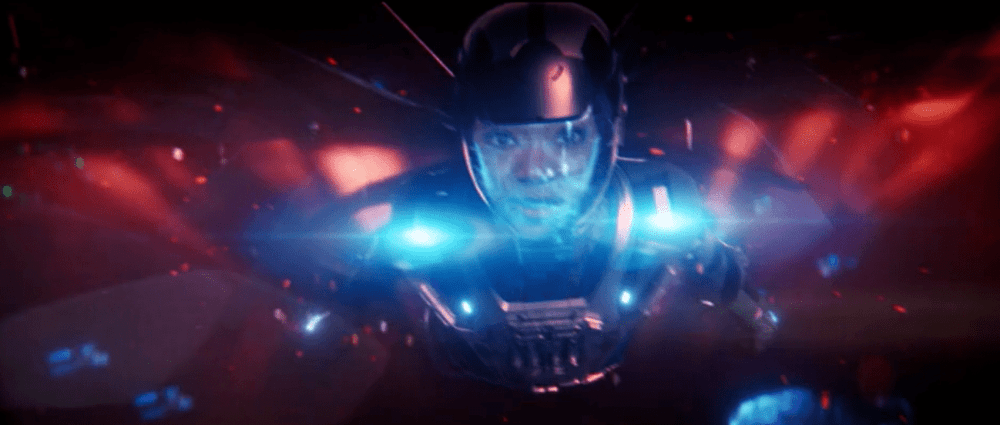
Once again, martyr Michael Burnham is the only one who can fly outside the ship and lead her crew into the 32nd century. Just imagine if Burnham and the Discovery flew into an even better century than the one they fled?
The original Star Trek was produced at the height of the Cold War, with young Americans dying daily in Vietnam, while Civil Rights icon Martin Luther King and presidential hopeful Robert F. Kennedy were being assassinated right at home; but it never succumbed to the hopelessness of its time. Star Trek’s eyes have always been on the prize—that gleaming future ahead. DSC, in its quest to become more contemporary, seemed to forget that Star Trek has never been a follower; in fact,it used to be a trendsetter. How wonderful it would’ve been to have Burnham and Saru lead Discovery into a future beyond what any of them could’ve imagined. And once again, like TOS and TNG, the conflict could’ve come from outside, as reflected in the various ‘strange new worlds’ the ship visits, using its spore drive.

In our own seemingly hopeless 21st century (unrelenting wars, climate change, the rise of authoritarianism), DSC could’ve bucked this downbeat trend with some old-fashioned, corny, but very welcome optimism. Instead, DSC often gave in to the pressures of this time, not its own imaginary future. Despite its opulent, cinematic production values and flashes of greatness every now and then, DSC is yet another frustrating example of unrealized potential within the Star Trek canon. While I have enjoyed certain aspects of DSC over these past seven years and five seasons, a part of me will always wonder about the Star Trek series that could’ve been with this show’s fantastic resources.

(you’ll have to see Star Trek Short Treks, 1.2: “Calypso“ for how that works out).
The coda of the series (“Life Itself”) sees Discovery freshly refit back to its 23rd century specs (for no reason that makes any kind of story-sense), so that it may drift in space for 1,000 years; a sleek powerful starship that is all dressed up, with nowhere to go. A more fitting metaphor for this series I couldn’t have imagined…
Future Spinoffs

While my own feelings for “Star Trek: Discovery” are decidedly mixed, there is no denying the show has made its share of passionate fans. There are at least two spinoff projects in the works, with the first being the “Star Trek: Section 31” spinoff movie (starring Michelle Yeoh), which recently wrapped production in March and should be released to Paramount+ sometime later this year or in early 2025. DSC’s other recently announced spinoff “Starfleet Academy,” will star Oscar-winner Holly Hunter, and is in preproduction for a possible Paramount+ release sometime in 2026.
Where to Watch
“Star Trek: Discovery” is available to stream on Paramount+ and is also available for purchase on physical media (seasons 1-4) through Amazon.com and through Barnes & Noble, as well as other online retailers (prices vary).

Well, I liked it better than you did, but I agree with some of your criticisms, and I really wish we could have gotten a season comprised of stand-alone episodes where we got to know the bridge crew better.
I’m still hard-pressed to remember their names, sadly.
And of course, the show has its strong passionate following, and that’s exactly as it should be. Goodness knows I love a lot of franchises and movies that some would deem…questionable. 😉
My feelings about Star Trek: Discovery were very conflicted, even with Sonequa and Michelle to breath new life into female empowerment for the Trekiverse. After the first season, I’m sorry to say I lost interest. But I appreciate how it revitalized Trek on TV after the trials and tribulations of Voyager and Enterprise. We may live in a time now when major controversies over the changes in our favorite sci-fi franchises are inevitable (certainly for Star Trek, Star Wars and Dr. Who). But individual fans always have their preferences and I can easily appreciate that. Thank you for your review.
I don’t blame you at all, Mike.
I stuck with DSC because I was always hoping it would fix its issues and get better. Over time, it became clear the show was doubling down on its weaknesses, instead.
I sooo appreciate DSC bringing greater inclusivity into the Star Trek universe (including the too long-ignored LGBTQ communities) and that it afforded such cinematic quality to the show and the fans; it was one of the best-looking Treks ever.
But over time, the issues of the show became too great to ignore.
Take care, Mike!
Thank you for this great write-up! I also have mixed feelings about Discovery, but overall I enjoyed it as much as I griped about it. It’s not my favorite Star Trek show, but I’ll never understand the burning hatred it seems to have inspired in many (although don’t pretend not to know the *real* reason why a very loud group hates it, and also I don’t pretend to believe that most of those people are actual Star Trek fans…). Most of Discovery’s problems, I think, come down to issues with the writing and storytelling, and to be honest, I’d rather have more Disco with more capable writers, than more Strange New Worlds, which is a “safer” and more evenly written show, but also it often feels too safe and cozy, while at least Disco attempted to do something new and interesting… even if it didn’t always manage to be successful.
Mixed sums up my feelings as well; I’ve met some of the cast and other creatives working on the show, and they’re lovely people, which I why I rooted for the show to succeed for as long as I did.
Now that it’s finished, I can look at it in totality, and analyze what worked and what didn’t work more objectively, and that was the aim of this column. Most of my issues are with how the show was written, not in its luxe execution, which was absolutely cinematic.
I certainly didn’t want to be lumped in with the “anti-woke” brigade because that is not who I am at all (anyone who’s read my column for any length of time should hopefully realize that).
Ultimately DSC was a sometimes misfiring launch pad for a whole new era of Star Trek, and for giving us Strange New Worlds and Prodigy alone, I’m plenty grateful. 😉
My feelings will always be mixed on this. There are things that I always liked about the show and will miss. There are characters that will resonate with me and moments that have stuck with me.
But there are very few episodes that I actively remember and want to revisit. Discovery, for me, has never risen to what I thought the sum of the parts should be, much less exceeded them.
And I think you can lay a lot of that at the feet of seemingly “mandatory” 10-episode, “solve the puzzle box” stories which somehow twisted time and space by being far longer than necessary to develop the story (The season arcs could have been told in 5 episodes or less) yet seemingly too busy to actually spend time to develop the characters.
They had five seasons to right the ship, and, I’ll miss the characters that I liked, but, mostly DSC is a bag of missed opportunities.
I loved Saru, and Dr. Culber, and others, but they deserved a better (stronger) series. I really wish they did the last season as a series of character-focused standalone stories; a bit of the late Michael Piller’s mojo for this show could’ve gone a LONG way.
I think that Discovery’s main problem was trying to so different in comparison to most previous Treks that it became too much for a lot of Trekkers like myself to take in. Thankfully it could open with two powerful women like Georgiou and Burnham which I naturally appreciated.
Wish Captain Georgiou (Prime version) remained the series’ lead, to be honest.
I adore Sonequa Martin Green (met her once, and saw her do a comedy sketch during a live taping of “The Wil Wheaton Project”), but Burnham has too much of a martyr-complex. It quickly became tiresome.
I really wish these characters were better served by the writing team.