
******STARSHIP-SIZED SPOILERS!******
The Promise
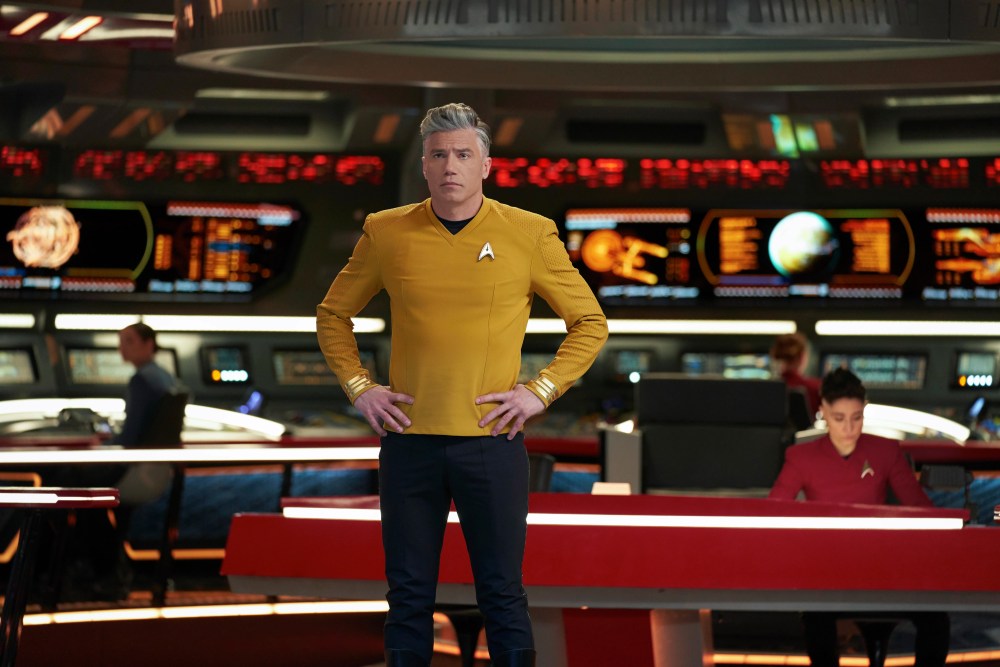
With Anson Mount’s Chris Pike at the helm, Star Trek: Strange New Worlds felt like a throwback to episodic Star Trek.
After a lot of speculation and advocation by fans like myself, “Star Trek: Strange New Worlds” (SNW) debuted in May of 2022 with one of the strongest pilot episodes of the nearly 60-year old Star Trek franchise. The SNW pilot, plainly-titled “Strange New Worlds,” was a tongue-in-cheek redux of director Robert Wise’s 1951 classic first contact film “The Day the Earth Stood Still” (an homage acknowledged in-story). The story worked elegantly within the Star Trek format, with Pike and Spock playing Klaatu and Gort to a hostile approximation of mid-21st century Earth currently playing its own deadly game of brinksmanship.

Captain Pike (Jeffrey Hunter) and Mr. Spock (Leonard Nimoy) from Star Trek’s original 1964 pilot, “The Cage,” which was later incorporated into the two-part framing episode, “The Menagerie” (1966).
Ever since I first saw Star Trek’s original series (TOS) only two-part episode “The Menagerie” as a kid (which cleverly incorporated Trek’s 1964 pilot “The Cage” in flashbacks), I’ve wondered what a Star Trek series led by the late Jeffrey Hunter‘s Pike might’ve been. Beyond Sean Kenney playing the disfigured, immobilized version of Pike in “The Menagerie,” other actors have played the character in live-action since, including Bruce Greenwood (“Nowhere Man”) in the alternate-universe reboot movies “Star Trek” (2009) and “Star Trek Into Darkness” (2013), which brings us to Anson Mount (“Hell on Wheels”) in SNW.

Captain Pike arrives to take command of the Discovery in the same-named series’ second season.
SNW was the series that some fans, like myself, had waited 50 years for. It promised to chronicle the largely untold story of the starship Enterprise under command of Captain Christopher Pike, deftly portrayed by Mount, who first played his version of Pike in Star Trek: Discovery’s (DSC), second season, where he often stole the show. While the problematic DSC rarely found its footing as a series, its second season was memorable largely for Mount’s interpretation of Chris Pike. Once it became official, the Pike-led Star Trek series generated waves of enthusiasm.

Star Trek: Strange New Worlds recast some legacy TOS characters.
Top left: Captain Christopher Pike (Jeffrey Hunter/Anson Mount) Top right: Mr. Spock (Leonard Nimoy/Ethan Peck) Bottom left: Una “Number One” Chin-Riley (Majel Barrett/Rebecca Romijn) Bottom right: Nyota Uhura (Nichelle Nichols/Celia Rose Gooding).
In addition to Mount’s Pike, the ensemble cast of SNW was a mix of legacy and new characters, including Rebecca Romijn as Una (“Number One”) Chin-Riley, Ethan Peck as Spock, Celia Rose Gooding as Ensign Nyota Uhura, Babs Olusanmokun (“Dune: Part One”) as Dr. M’Benga and Jess Bush as Nurse Christine Chapel. All-new characters included helm officer Erica Ortegas (Melissa Navia), security chief La’an Noonien Singh (Christina Chong) and ill-fated blind Aenarian chief engineer Hemmer (Bruce Horak). With its diverse cast, that first season of SNW was largely successful (“Children of the Comet,” “Ghosts of Illyria, “The Serene Squall”) despite a few clunkers (“Kingdom of Elysium,” “A Quality of Mercy”).

An alternate-universe James Kirk (Paul Wesley) and Lt. La’an Noonien Singh (Christina Chong) find romance in 21st century Toronto in the excellent second season time-travel episode “Tomorrow and Tomorrow and Tomorrow…”
While I wasn’t thrilled with the idea of Lt. La’an Singh being directly related to Star Trek villain Khan Noonien Singh, the character–and actress–eventually grew on me; particularly with season two’s heartbreaking 21st century time-travel romance “Tomorrow and Tomorrow and Tomorrow.” That memorable episode again brought Captain Kirk (Paul Wesley) back to the series, while carefully tap-dancing around canon-shattering issues. “Tomorrow…” even offered an in-universe explanation for why its future didn’t unfold the way TOS Star Trek predicted (damn you, time-travelers…). Season 2 also gave us a conclusion to Una’s arc regarding her genetically-engineered past (“Ad Astra Per Aspera”), as she petitioned to keep her position in Starfleet by using her character’s refugee status to enact a Federation asylum clause.

Season 2’s goofy-but-fun “Subspace Rhapsody” wan’t the distaster I initially anticipated.
While it started off strong, season 2 offers up a few stories that were decidedly hit-and-miss, including the musical episode “Subspace Rhapsody” (which I surprisingly enjoyed), “Those Old Scientists” (the Star Trek: Lower Decks crossover), and the season finale “Hegemony,” which reimagined TOS’ classic foes the Gorn as little more than tiresome “ALIEN” xenomorph rip-offs. After a successful first season and the promising beginning for the second, I found myself increasingly frustrated with this series.

I know I’m supposed to like her, but chief engineer Pelia (Carol Kane) is about as lovable as an earache, while her legacy character apprentice Scotty (Martin Quinn) barely looks old enough to have his first Aldebaran whiskey.
Matters weren’t helped with the late chief engineer Hemmer’s replacement; a 5,000-year old, deeply-annoying kleptomaniac named Pelia (Carol Kane), who later brings a Muppet Babies version of future Enterprise chief engineer Montgomery Scott (Martin Quinn) onto the ship as her assistant. For some reason, this new Scotty is at least a decade or so younger than Captain Kirk (?). Granted, actor Martin Quinn is an authentic Scotsman, but his Scotty looks like he barely graduated from the Academy. This younger Scotty is brought aboard four years before Kirk’s five year mission, where we saw Scotty as a middle-aged veteran.
Despite the missteps of season 2, season 3 is where the plomeek soup really hit the air-ventilation shafts…
Season 3 (so far)

As of this writing, the third season is seven episodes in, with three left to go. However, watching SNW has become more of a weekly exercise in disappointment than anticipated escapism. SNW’s third season began with the so-so conclusion to “Hegemony Part 2,” and the absurd comedy “Wedding Bell Blues.” “Hegemony Part 2” ends with Pike and the crew putting the Gorn into a false hibernation–just like how Data and Picard put the Borg “to sleep” in TNG’s “Best of Both Worlds, Part 2.” “Wedding Bell Blues” brings back TOS’ foppish demigod, Trelane (now played by Rhys Darby), rebranding him as the son of “Q” (John de Lancie) from Star Trek: The Next Generation (TNG). For a series that promises ‘strange new worlds’ in its very title, the first two episodes of the third season offered a pair of creative retreads.

Trelane/Q (Rhys Darby) makes himself known to Starfleet by wreaking havoc at Starbase One–only to be conveniently forgotten a few years later when he’s re-encountered by Kirk and company in TOS’ “Squire of Gothos.”
That trend towards the familiar continued as season 3 later gave us zombie Klingons (“Shuttle to Kenfori”), another in a long line of malfunctioning holodeck episodes (“A Space Adventure Hour”) and yet another return of Captain Kirk (“The Sehlat Who Ate Its Tail”), who is pretty much a series semi-regular now. SNW’s Kirk gets more quality time and development than Melissa Navia’s Erica Ortegas, whose only other character traits besides “flying the ship” are PTSD from her Gorn encounter and a latent tendency towards insubordination. I miss the charismatic character from season 1.

An insubordinate Ortegas (Melissa Navia) in an uncomfortable meeting with Number One in “Shuttle to Kenfori.”
Ever since season 1’s “Quality of Mercy,” it feels as if the show has been steadily pushing Captain Pike out to pasture to make way for the younger, headstrong Captain Kirk–almost to the point where Pike is made to look borderline incompetent (“Hegemony, Part 2”). I understand producer Akiva Goldsman is clearly paving the way for a future Kirk-led series (“Star Trek: Year One”), but there’s a snag…we already had that series 60 freaking years ago.

Beginning with “A Quality of Mercy” in season 1, Paul Wesley’s Kirk has made so many ‘guest appearances” that he’s more or less a regular cast member at this point.
This may sound odd, but I was actually looking forward to SNW being Captain Pike‘s show, not Captain Kirk’s. Kirk has already headlined TOS, The Animated Series, and ten feature films. Enough is enough. I realize we live in the franchise-era of entertainment where everything has to be based on a proven intellectual property to get a green light, but seriously; do we really need another Star Trek series featuring Captain Kirk…?

Christine Chapel (Jess Bush) with her fiancé and future mandroid Dr. Roger Korby (Cillian O’Sullivan).
A lack of originality isn’t the third season’s only issue. There’s also a distinct lack of queer representation in the series this year. Chapel’s previously hinted bisexuality in season one (“Spock Amok”) has given way to her canonical engagement to Roger Korby; who’s been reimagined from TOS’ silver-haired, Bronx-accented mandroid (Michael Strong) into a tall, hunky Irishman (Cillian O’Sullivan) right out of a bodice-ripper romance novel. Ortegas is implicitly queer, but even after three seasons, we still haven’t seen her in any kind of relationship. Maybe she’s asexual? That might be genuinely interesting to explore as well, since we’ve never seen an asexual human character in Star Trek.

Captains Batel (Melanie Scrofano) and Pike are still together aboard the Enterprise… for now.
Currently, the third season of SNW has no less than four heterosexual couplings aboard the ‘Love Boat’ Enterprise; Pike and the still-recovering Captain Batel (Melanie Scrofano), Uhura and Ortegas’ documentarian kid brother Beto (Mynor Luken), the aforementioned Chapel and Roger, and finally, Spock and La’an Singh (which is supposed to be a rebound, friends-with-benefits thing). Not one hint of queerness in the lot. This is both disappointing and a bit distressing, especially in these increasingly reactionary times. It feels tone-deaf and cowardly for Star Trek to meekly recede from queer representation at a time when it’s needed most (see: George Takei’s graphic biography “It Rhymes with Takei”). While DSC certainly had its share of flaws, LGBTQ+ representation was never one of them.

Spock coaches his future boss on how to be captain in “The Sehlate Who Ate Its Tail” (one of the worst titles of this season).
Also disturbing is this season’s lack of episode themes or subtext. Of the seven episodes streamed to date as of this writing, none have tackled anything socially relevant. “The Sehlat Who Ate Its Tail” is about the USS Farragut’s first officer Kirk taking command for the first time after his captain is injured in an attack by 21st century humans who’ve devolved into Trek’s equivalent of the ‘Reavers’ from “Firefly”/“Serenity.” Four years before he takes command of Enterprise, and Kirk is stymied with indecision. Ultimately, Kirk is forced to kill the Reavers since their rapacious appetite for planets and technology have made them human Doomsday Machines. There’s no greater theme or point to this episode.

Ensign Gamble (Chris Myers) is reduced to an eyeless, soulless boogieman as M’Benga watches in “Through the Lens of Time.”
So far, season 3’s episodes have been Star Trek stories in the most shallow sense. There is no greater Star Trek-style social commentary or depth. There is plenty of event, but very little to say. A recent episode, “Through the Lens of Time,” began as a Federation archeological expedition (with a landing party composed of three romantic couples, no less) that soon devolves into an elaborate escape room to be solved (with a ‘leap of faith’ bit shamelessly stolen from “Indiana Jones and the Last Crusade”). Meanwhile, a likable ship’s nurse is transformed into an eyeless, possessed monster that is evil for evil’s sake. No meaning, no point. Just event.
The most recent episode, “What is Starfleet?” breaks from the series regular format to tell a story from Beto Ortegas’ documentarian perspective. What could’ve been SNW’s equivalent of the Clete Roberts faux-newsreel episodes of “M*A*S*H” falls woefully short. Instead of depicting Beto as a professional journalist, the episode makes him out to be a voyeuristic little shit for daring to ask legitimate questions regarding Starfleet’s transport of a weaponized alien life-form to be used as a bioweapon in an interplanetary war; a violation of everything Starfleet allegedly stands for.

In the end, everything is pooh-poohed after Beto changes his approach and chooses to humanize the Enterprise crew for assisting the space whale’s suicide rather than letting it live in agony. Beto’s newfound shift in perspective doesn’t change the crew’s role in an otherwise monstrous act. Not to mention that Beto’s role as objective journalist is seriously compromised by his relationship with Uhura. This episode lacks the courage to take a stand on any of the questions it raises.
The Depiction of Spock and Vulcans

Amazing that Spock failed to remember Khan Noonien Singh was his ex-lover’s ancestor in TOS’ “Space Seed.”
Getting back to the character of Spock, the half-human, Vulcan-identifying character has now been reimagined as the ship’s stud, despite being depicted for nearly six decades as a cool, aloof science officer whose relationship with lovesick Nurse Chapel was forever unrequited (“The Naked Time,” “Amok Time,” “Plato’s Stepchildren”). Spock also coolly dismissed Uhura’s flirtations in TOS “Charlie X” and “The Man Trap,” as well. Now he sleeps with his human colleagues (including Chapel) on a whim. This feels wildly uncharacteristic . It also ignores and negates Spock’s spore-driven relationship with human botanist Leila Kalomi (Jill Ireland) in TOS’ “This Side of Paradise,” which was supposed to mark the first time in his life that Spock was “happy.” Now Spock allows himself to get all kinds of ‘happy’ with human women.

“This Side of Paradise” was implicitly the first time Spock (Leonard Nimoy) made love to a human woman, Leila Kalomi (Jill Ireland), a botanist who fell for him six years earlier on Earth, yet who’s curiously absent from “Strange New Worlds.”
I’ve made no secret that Spock is my all-time favorite character (“Why Mr. Spock truly is the center of the Star Trek universe”), and has been since I was a kid. Meeting Leonard Nimoy in 2009 was (and is) a highlight of my life in semi-professional geekdom. What also disturbs me is how Spock has become the Trek equivalent of Sheldon Cooper; a neurodivergent punching bag for the ‘normal’ human characters to either mock or have sex with. Nearly every episode dealing with Vulcans has been a comedy (“Spock Amok,” “Charades,” “Four and a Half Vulcans”). Vulcan cultural emotion suppression is treated as a galactic joke, just like Ferengi greed. Vulcan wisdom and dignity have been shot to hell.

The SNW version of Spock doesn’t ‘get’ human humor, even though TOS’ Spock used to slyly smile or raise an eyebrow in acknowledgment whenever one of his colleagues dropped a quip his way. Even when TOS’ Dr. McCoy (De Forest Kelley) would mock him, Spock would coolly deliver a scathing retort. Spock always got the joke, even though he pretended not to. Defenders of SNW Spock might say his differing behavior in SNW is because this is a younger version of the character. However, SNW is now only three or four years from Kirk’s original five year mission, so that argument holds as much water as the desert sands of Vulcan’s Forge.

Pike, La’an, Uhura and Chapel are transformed into Vulcans in the upcoming “Four and a Half Vulcans,” the preview of which shows a profound misunderstanding of Vulcan culture.
As I’ve already stated in my 2024 column on the forthcoming episode, “Four and a Half Vulcans,” the writers and producers of SNW have a fundamental misunderstanding of Vulcans. Vulcans are not without emotions. In fact, they feel as deeply and passionately as humans; arguably more so, in fact. The rampant emotions of Vulcans nearly destroyed their civilization two thousand years ago, which is why they’ve since adopted a permanent philosophy of emotional suppression. The three minute preview I saw of “Four and a Half Vulcans” from San Diego Comic Con 2024 featured Pike, Chapel, Uhura and La’an transforming into Vulcans for a sensitive mission. They achieved this transformation not through cosmetic surgery (à la TOS’ “The Enterprise Incident”), but with some of Chapel’s magic DNA elixirs (as seen in the “Strange New Worlds” pilot), meaning they physiologically transformed into Vulcans; which somehow made them instantly logical and unemotional. Yeah, that’s not how Vulcans work, guys…

I am a big fan of comedian Patton Oswalt, but his future Star Trek role as an apparently lovesick Vulcan looks simply awful.
Vulcan logic and emotional suppression is achieved through continuous practice and discipline; like martial arts or meditation. It’s not delivered by a hypo, any more than one can learn Chinese through a transfusion of blood from Beijing, or how to make authentic strudel using blood from Bavaria. Even if transforming from one species to another were possible on a DNA-level, it couldn’t give you the culture. The suppression of emotion is part of Vulcan culture, not DNA. Culture comes from observation, immersion and life experience, not a syringe. We’ve already seen other Vulcans in Star Trek who’ve deliberately strayed from logic, including Spock’s half-brother Sybok (a character seemingly being poised for a comeback in SNW’s first season) and the V’tosh ka’tur from Star Trek: Enterprise (ENT). Those Vulcans broke from their society’s enforced mental disciplines by choice, not by altering their genes. The depiction of Vulcans in SNW is at odds with prior lore, and feels terribly speciesist.
“No meaning, no hope…”
This lack of meaning and/or social commentary in SNW’s third season might be the result of Paramount’s recent merger with Skydance; deal that’s been slowly percolating since early 2024. This is around the time that SNW’s third season was in production (production of season 3 wrapped in May, 2024). Skydance Media has had rumored dealings with Trump Media, and the administration’s approval was required to seal the deal with Paramount.

With President Trump’s hands in various cultural cookie jars (including the Smithsonian and the Kennedy Center) it would be no great surprise to learn that SNW’s sudden dearth of subtext, social commentary and LGBTQ+ representation might very well be connected to the current occupant of the White House. It’s hardly a secret Trump has long sought to reshape American news media and entertainment to his preferred specifications (which should legitimately scare the hell out of everybody).

The young de facto crew of the USS Protostar in “Star Trek: Prodigy” really gave it their all. This series was one of the most pleasant surprises in recent Star Trek offerings.
Shifting gears a bit, the recent animated series “Star Trek: Prodigy” (PRO) was perhaps the closest thing I’ve seen recently to consistently good Star Trek. It had a nice mix of legacy and new characters, while reintroducing new audiences to all those things that made Star Trek unique and special. Naturally, it was unceremoniously dumped by Paramount+ before being canceled on Netflix as well. I’m fairly sure we won’t see its reemergence anytime soon.
What’s Next?
The next episode streaming will be “Four and a Half Vulcans,” which I’m anticipating with all the eagerness of a root canal from a back alley dentist. After that, there are two more episodes in the pipeline: “Terrarium,” and “New Life and New Civilizations.” With seventy percent of the third season to date being somewhat less-than-promising, my hopes are somewhat dashed that the final thirty percent of the season will somehow redeem the rest of it. Despite my criticisms of this current season, I have over five decades of emotional investment in Star Trek, and I desperately want it to succeed.

However, at this point, it feels like I’m watching “Star Trek: Strange New Worlds” largely on autopilot. Many things I enjoyed about its first two seasons have largely evaporated from the show. We’re left with a dazzlingly well-produced shell of Star Trek, with none of the social commentary or courage of its predecessors. Despite this depressing downward creative spiral, I’m old enough to have seen Star Trek survive many slumps, only to see it rebound spectacularly at some future point. While my optimism for this current series has taken a blow to the solar plexus, I know better than to count Star Trek as fully out. As Spock says, “There are always possibilities…”
Live long and prosper, folks.

Curiosity as well as the feedback from some pen pals has kept me tuning into Strange New Worlds for this new season. At this point I prefer to be more optimistic about Starfleet Academy. Even if it may also have its share of extravagant episodes, seeing them set in a distant future for the Federation instead of any pre-classic-Trek era could feel more comforting. The most recent SNW episode allowing us to view Pike’s crew from a documentary perspective was fairly interesting. The ending reminds me how Picard’s crew on their first adventure saved an extraordinary alien being from being exploited. As a most common Trek message on the equal respect we should have for all lifeforms, even if that might sometimes include our enemies, it earns points for reassuring us that some of the best Trek magic may still be refreshed. Thank you for your review.
Appreciated, Mike. I will try to keep my optimism reservoir full when “Starfleet Academy” comes out. 😉
What I’m always most optimistic about is all the powerful roles for women in the new Star Treks these days. La’an has become my favorite because I find her character to be the most interestingly dimensional.
La’an grew on me a bit, but I’m not exactly thrilled with her role (or any others) in “Four and a Half Vulcans,” which was even worse than I thought it might be.
I’ll probably skip that episode what I saw of it in the trailer.
You’re not missing anything. It was much worse than I expected; one of the all-time worst episodes of the entire franchise (and that’s being generous).
I know you’ve tended to view things more kindly, but a lot of what you say here captures how I’ve felt about all of modern Star Trek (Prodigy excepted), and why I stopped watching SNW after one season. I really, truly believe that the people currently in charge of the franchise just don’t understand what Star Trek is supposed to be. They may know all the references, but that doesn’t mean they *get it*.
I keep going to that bit M’Benga had in the first season about how (paraphrasing) when humanity moved to the stars, they didn’t really evolve, they just exchanged old bigotries for new ones. That’s where they gave away the game for me because that’s the exact opposite of Star Trek’s core premise.
This also puts me in mind of a post I’ve been meaning to do on my blog about the issues with how legacy media franchises are handled these days. Let’s see if I can finally find the motivation to write it…
I look forward to reading it.